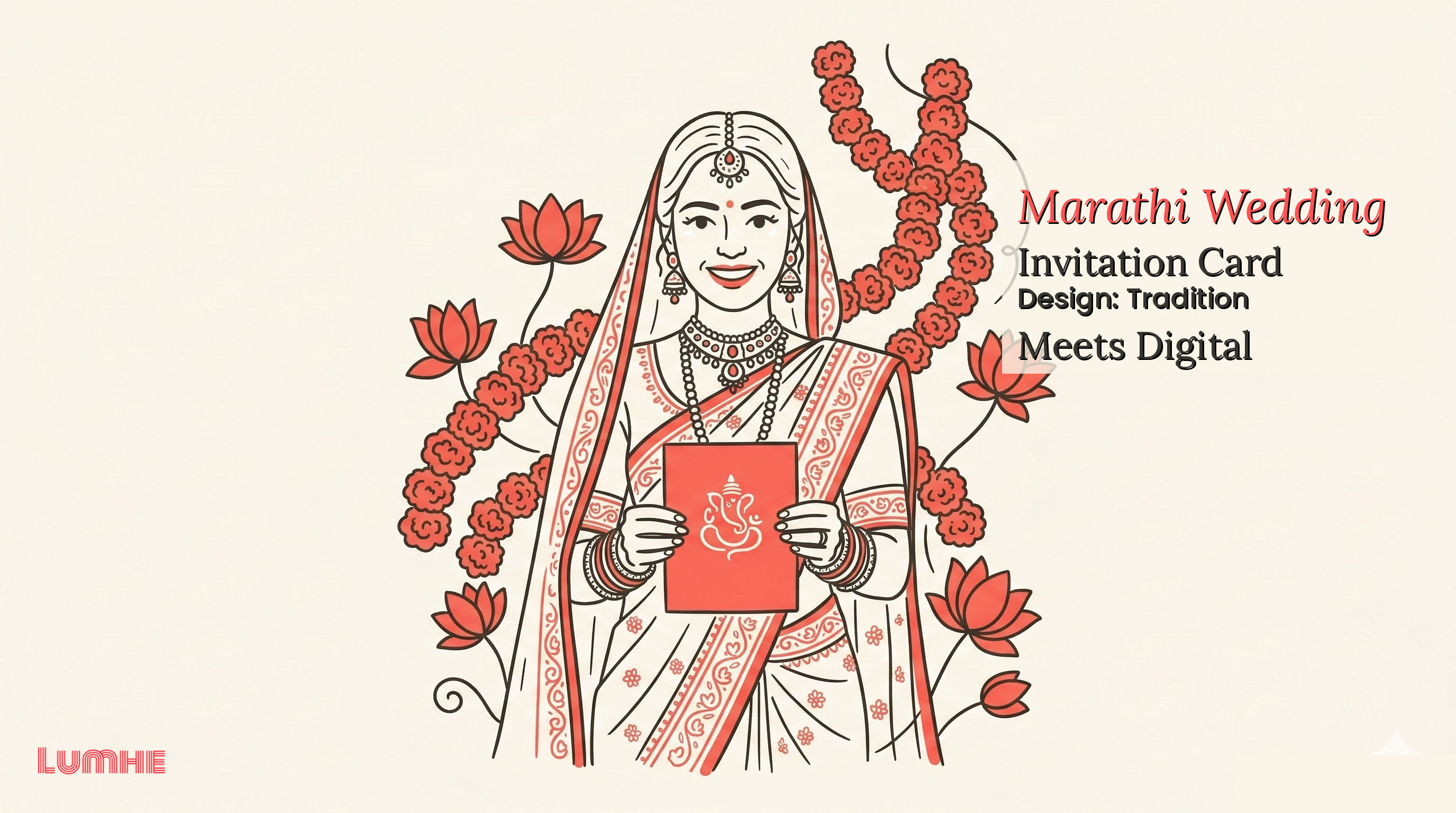
The font choice, the wording, the order in which names appear, which deity's image sits at the top — all of it is noticed. Aunts compare cards. Grandmothers read them aloud. The card is an announcement, yes, but it is also a statement of who your family is.
This guide covers everything you need to know about Marathi wedding invitation card design — what to include, how to word it correctly in Marathi, what the traditional elements mean, and how digital invitation cards are changing the way Marathi families invite their guests today.
What Goes on a Marathi Wedding Invitation Card
A well-designed marriage invitation card in Marathi follows a structure that has been refined over generations. While modern cards have become more creative with layouts and design, the core elements remain consistent.
1. The Deity (देवता)
Almost every traditional Marathi wedding invitation opens with an image or invocation of a deity — most commonly [God's Name] ([God's Name] Namah: [God's Name] Namah). This is not decorative. It is an act of seeking blessings before the announcement. Some families also include the family deity (कुलदेवता), especially in more traditional households.
2. Family Introduction (कुटुंब परिचय)
Before the couple is named, the families are introduced. On the bride's side: her father's name, mother's name, and often her maternal uncle (मामा) — whose role in Marathi weddings is significant and is explicitly acknowledged in the invitation. The same structure follows for the groom's side. The order matters: elders are named before the couple.
3. The Couple (वर-वधू)
The groom (वर) and bride (वधू) are introduced by name. In Marathi tradition, the wording here is often in Sanskrit-influenced Marathi — formal and graceful. A common phrasing:
"... यांच्या सुपुत्राशी... यांच्या सुकन्येचा विवाह..."
(The son of... is to be married to the daughter of...)
4. Wedding Details (विवाह माहिती)
- Date (तारीख) — both the English calendar date and the Hindu calendar date (tithi) are often included
- Time (वेळ) — specifically the muhurta (शुभ मुहूर्त)
- Venue (ठिकाण) — full address, with landmarks if relevant
5. Sub-events (कार्यक्रम)
Marathi weddings typically span multiple functions: Haldi (हळद), Mehendi (मेहंदी), Sangeet (संगीत), the main wedding ceremony (विवाह सोहळा), and the reception (स्वागत समारंभ). A complete wedding invitation card matter lists each function separately with its date, time, and location — because different guests attend different functions.
6. Invitation Line (आमंत्रण)
The closing line formally invites the guest. A traditional example:
"आपण सकुटुंब, सपरिवार येऊन आशीर्वाद द्यावेत, ही विनंती."
(We humbly request you to come with your family and bless us.)
This line, simple as it appears, carries warmth and humility — hallmarks of Marathi hospitality.
Traditional Design Elements in Marathi Wedding Cards
When it comes to invitation card design in Marathi, aesthetics and symbolism go together.
Rangoli and Warli patterns are among the most recognisable elements. Warli, the tribal art form from Maharashtra, uses geometric white patterns on a terracotta or dark background — and has found a beautiful place in modern Marathi wedding card design. It feels rooted and contemporary at the same time.
Colours traditionally used include deep red (लाल), saffron (केशरी), and gold (सोनेरी) — colours associated with auspiciousness and prosperity in Maharashtrian culture. Ivory and cream backgrounds with maroon or green borders are also widely used.
Typography for a Marathi wedding invitation card design needs to handle Devanagari script elegantly. Not all fonts render Marathi well — especially when the card has Sanskrit shlokas or formal Marathi. Fonts like Mangal, Shobhika, or custom calligraphic Devanagari fonts are preferred for the main text. English details (venue addresses, phone numbers) are typically set in a complementary serif or elegant sans-serif.
Border and frame design in Marathi cards often features temple arch motifs (गोपुर), lotus flowers (कमळ), and peacock (मोर) patterns — all auspicious symbols in Hindu and Marathi culture.
Marathi Wedding Invitation Card: Modern vs Traditional
The marriage invitation card design in Marathi has evolved significantly over the past decade. Two clear styles have emerged:
Traditional print cards remain the choice for families who want something that can be physically handed over — especially to elders, relatives in villages, and guests who are not comfortable with digital devices. These are printed, often in sets of 200–500, and handed out personally or sent by post.
Digital invitation cards have grown rapidly since 2020, and for good reason. A digital Marathi wedding card can be shared instantly on WhatsApp to hundreds of guests, can include a Google Maps link for the venue, can carry RSVP options, and can be beautifully designed — often matching or exceeding print cards in visual quality.
Many families today choose both: a small print run for elders and close family, and a digital version for the broader guest list.
What to Write: Marathi Wedding Invitation Card Matter
The wedding invitation card matter in Marathi is where many families spend the most time — and where the most questions arise. Here is a straightforward template structure:
॥ [God's Name] Namah ॥
(Bride's father's name) व (Bride's mother's name) यांचे सुपुत्र / सुकन्या
(Groom / Bride's name)
यांचा शुभविवाह
(Groom's father's name) व (Groom's mother's name) यांचे सुपुत्र / सुकन्या
(Bride / Groom's name)
यांच्याशी होत आहे.
शुभ मुहूर्त: (Date), (Time)
ठिकाण: (Venue name), (Full address)
आपण सकुटुंब येऊन आशीर्वाद द्यावेत, ही विनंती.
This is the core. Around it, you add the sub-event details, any additional text from the family, and the design elements discussed above.
How Lumhe Makes Marathi Wedding Invitations Easier
Managing a Marathi wedding guest list is genuinely complex. You have different functions — and not every guest attends every one. Haldi is close family. Sangeet is friends and younger relatives. The main ceremony is everyone. The reception is often the largest.
When you create your wedding on Lumhe, each function gets its own separate section. You can invite specific guests to specific functions — not just bulk-invite everyone to everything and then manually track who said yes to what. Your guests receive a clean, beautiful digital invitation that they can open, RSVP to, and share further — without the "Forwarded" tag that WhatsApp puts on bulk-sent content.
Your wedding invitation card in Marathi can go out as a single shareable link. When it reaches guests who then share it with their family members, the invitation still looks complete and professional. And you can see in real time who has confirmed attendance for each function — so when you're finalising catering numbers for the Haldi separately from the reception, you have the actual data.
One Last Thing: The Card Is the Beginning
A Marathi wedding is rich with ritual, colour, and detail. Your invitation card — whether printed or digital — sets the tone for all of it. Take the time to get the wording right. Make sure the deity invocation is placed with care. Check that every elder on both sides is acknowledged correctly.
And then send it with the same warmth that has always been at the heart of Marathi hospitality — ये, आशीर्वाद दे.
Planning your Marathi wedding? Upload your invitation card — whether you've designed it as an image, PDF, or video — to Lumhe, add your functions (Haldi, Mehendi, Sangeet, Ceremony, Reception) with their dates, times, and venues, and share it with your guests directly or via a WhatsApp link. Each function gets its own RSVP tracking. You see who's confirmed for the Haldi separately from the Reception. Explore Lumhe here.
Lumhe lets you upload any invitation, manage RSVPs across multiple wedding functions, and share it via link on any platform — for Marathi weddings and every Indian celebration.