Paper Shagun vs Digital Lifafa: Why Couples Are Making the Switch
Shagun has always been about more than money.
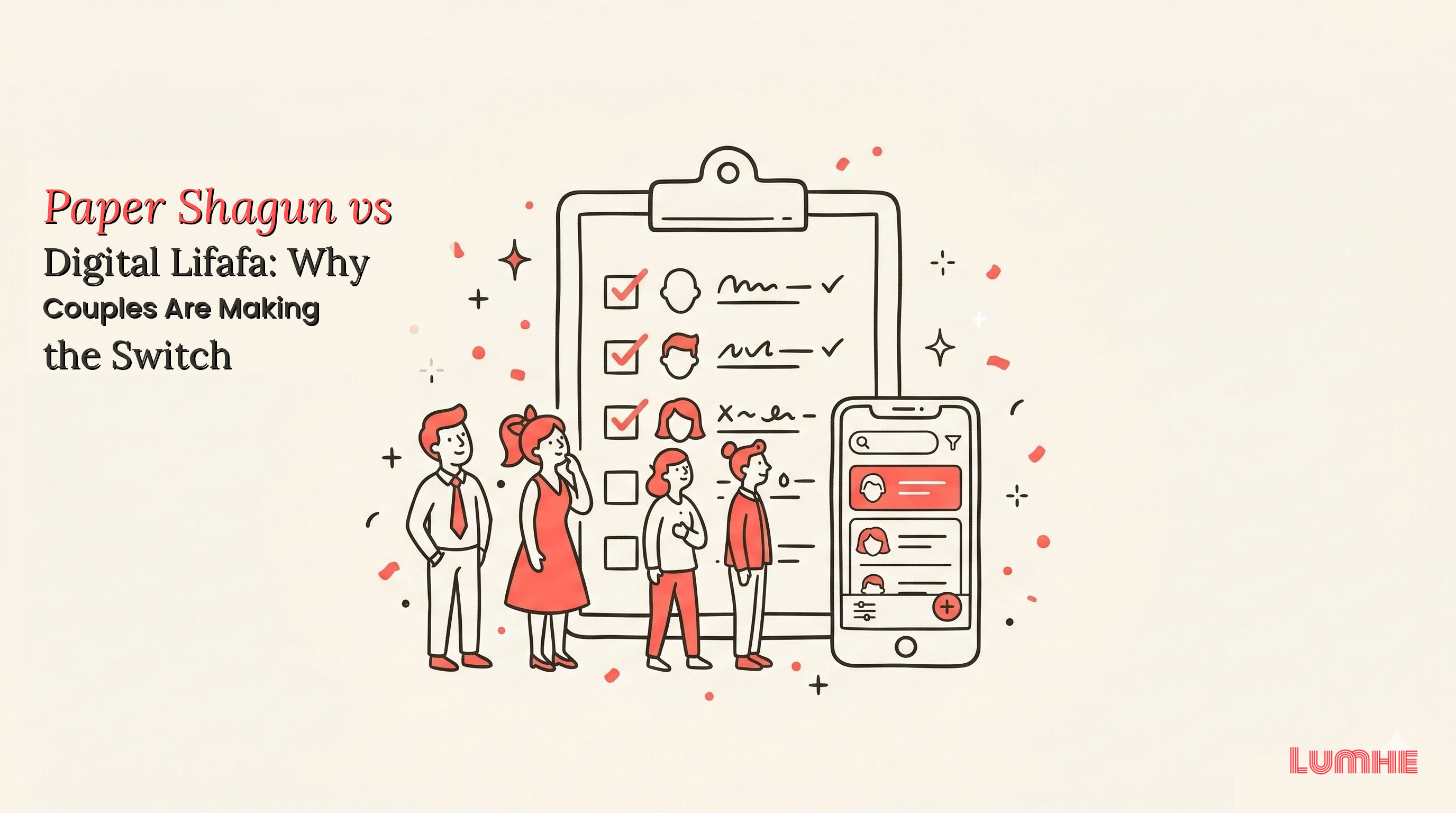
Shagun has always been about more than money.
The decorated envelope, the brief ceremony of handing it over, the acknowledgement from the family receiving it — these are not incidental to the gift. They are part of it. The physical lifafa carries the intention in a way that a bare bank transfer does not.
This is why, when digital lifafa options first appeared at Indian weddings, the reaction from many families was cautious. "It feels impersonal." "Our relatives won't use it." "Shagun is supposed to be physical."
These concerns are understandable and, to some extent, valid. But the reality of how digital lifafas actually function at weddings has turned out to be more nuanced than the initial reaction suggests — and many families who started sceptical have found that the two approaches are not as opposed as they initially seemed.
This guide looks honestly at both.
The ritual is intact. A physical lifafa — a decorated envelope with cash — is a complete ritual in itself. The guest brings it, hands it to a family member, and the exchange is a moment of acknowledgement. For close family relationships, especially with elders, this moment matters. It is not just about the money.
It carries cultural specificity. Different communities have specific lifafa traditions — the colour, the design, the way it is presented, the family member who receives it, the words spoken at the exchange. A physical lifafa participates in these traditions fully. A digital transfer, however convenient, does not have the same cultural texture.
It is universally accessible. Cash does not require a smartphone. The elderly guest who does not use apps can bring a physical envelope without any difficulty. The physical lifafa includes everyone.
It is immediate and tangible. The guest who hands you a lifafa at your wedding and the lifafa that sits in the box on the family table — these are present at the event in a way that a digital notification is not.
Cash security across multiple days. At a four-day wedding with five functions, the physical lifafas accumulate. They need to be kept secure, counted, and reconciled — across a venue full of hundreds of people, during events where the family's attention is understandably elsewhere. Cash management at Indian weddings is a real logistical challenge that most families handle less well than they would like.
The record-keeping problem. The person at the receiving table noting names in a register — under pressure, during a busy event, often while managing multiple conversations simultaneously — misses names, misspells them, or loses track of which function the lifafa was brought for. After the wedding, the reconciliation of who gave what is partially based on memory and partially guesswork.
Guests who cannot attend cannot easily send shagun. A family member who is abroad, unwell, or simply unable to travel has no easy way to send a physical shagun lifafa in time for the wedding. The informal workaround — a bank transfer with a note — is functional but lacks the form of shagun. The guest often feels the absence of the physical gesture.
International guests. NRI relatives who genuinely want to give shagun but have no way to send cash from abroad are in an awkward position. The alternatives (sending it through a relative in India, doing a bank transfer) are not ideal and sometimes create more logistical complexity than they solve.
It reaches guests who cannot be present. This is the clearest practical advantage of a digital shagun for wedding: it allows guests in other cities, other countries, or simply unable to attend to send shagun directly. The intention is preserved; the presence is not required.
It is trackable. Every digital lifafa sent through a platform like Lumhe creates a record: the sender's name, the amount, the function it was sent for (since it integrates with the RSVP flow), and a timestamp. This makes post-wedding acknowledgements accurate rather than reconstructed from memory.
It integrates with the invitation. When the digital shagun option is part of the same link guests use to confirm their wedding function RSVP, the invitation and the shagun are connected. A guest who confirms for the reception and sends their shagun does both from one interface, and both pieces of information are recorded together.
No cash management risk. Money received digitally does not need to be kept secure in a box at the venue, does not get misplaced in the chaos of a busy event, and does not require a dedicated person to manage the receiving process.
It does not replace the ritual for close relationships. For the uncle who has known you since you were born and for whom handing you a lifafa personally is part of what the wedding means, the digital option is not the right choice. Nor should it be offered as the only option.
Adoption varies. Not every guest will click through a link and send a digital shagun. Some will not be comfortable with the technology. Some will simply prefer the physical gesture. The digital option works best as an additional channel, not a replacement.
The ceremony of the exchange is absent. A digital transfer is clean and convenient. It does not have the warmth of a handover at a wedding. For some occasions and some relationships, this matters more than the practical benefits.
The families who have integrated digital lifafa most successfully are not using it to replace paper shagun — they are using it as an additional channel for specific situations:
For guests who cannot attend in person. For NRI relatives abroad. For close friends who want to send in advance. For older guests who find an envelope difficult to carry to the venue. For the guests who simply prefer the convenience.
Physical lifafas continue for the guests who bring them — elders, close family, anyone for whom the physical exchange is meaningful. The two coexist without friction. The family receives both, acknowledges both, and records both — the digital records cleanly through the platform, the physical through whatever system they use for the envelopes.
The result is that more shagun arrives — from more people, with less lost — than the physical-only approach would produce.
The choice between paper and digital is not actually a choice between tradition and modernity. It is a choice about which guests you want to include.
A physical-only approach includes everyone present and excludes everyone who cannot be. A digital option extends the invitation to give shagun to every guest — wherever they are, whenever they are ready.
The tradition is not diminished by adding a channel. It is extended.
Planning your wedding and want to include a digital lifafa option alongside physical shagun? Explore Lumhe here.
Lumhe lets you upload any invitation, add a digital shagun lifafa option, and manage RSVPs per function — for weddings, engagements, and every occasion worth celebrating properly.
Design a beautiful event invitation in seconds and share it with a link — free, no app needed.
Why separate RSVPs per wedding function saves time, money and headcount confusion — and how to set it up without a spreadsheet.
An honest comparison of digital and printed wedding invitations in India — cost, convenience, tradition and what modern couples prefer.
Find farewell invitation card wording for office, college and retirement parties. Heartfelt, funny and formal messages included.