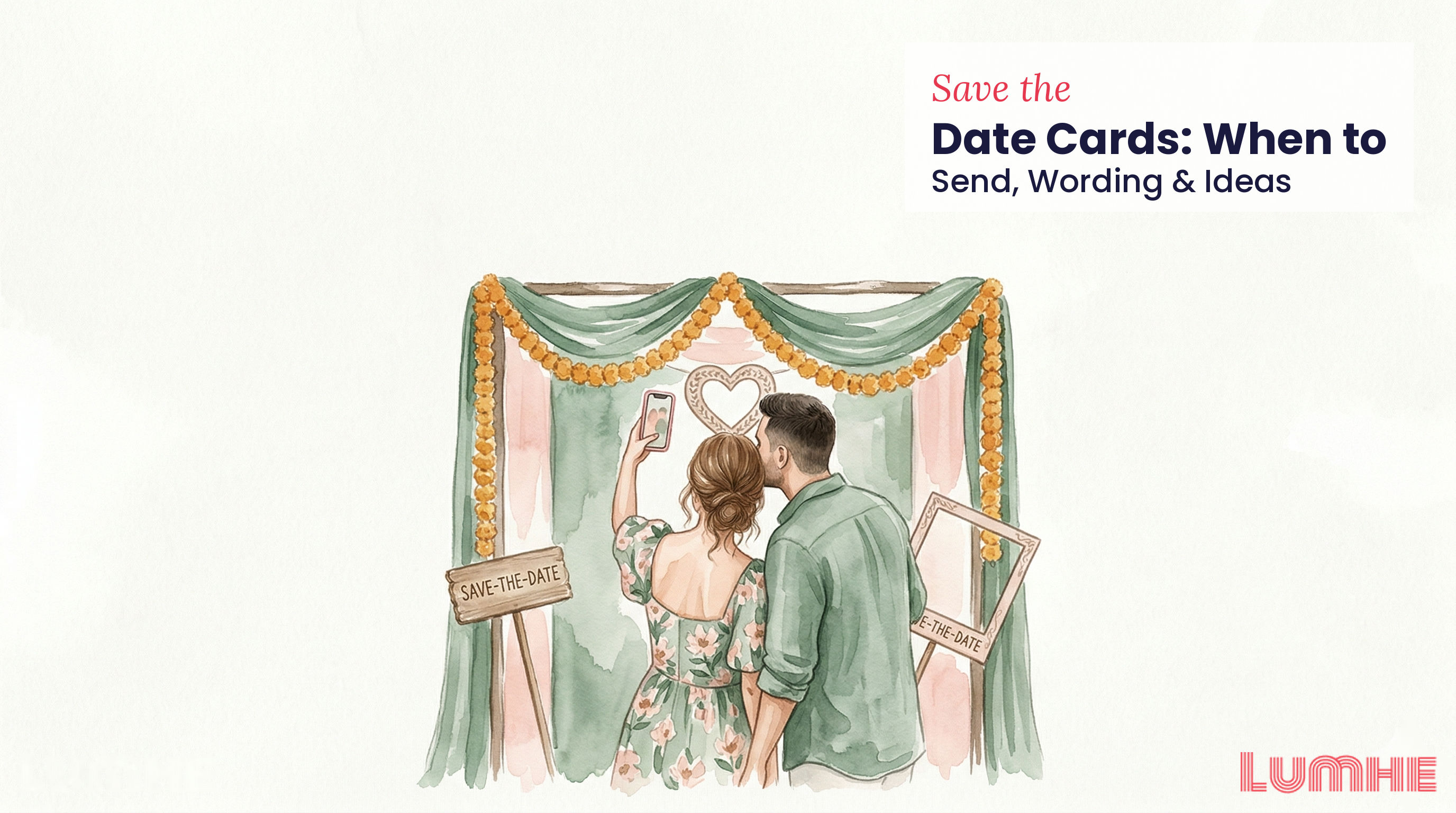
Timeline matters: Save the dates should go out 6–8 months before your wedding (or earlier for destination weddings). Wedding invitations arrive 6–8 weeks before the event. This two-stage approach gives guests time to plan ahead and budget for travel or time off work.
For more inspiration, explore Hen Party Invitations.
| Timing | 6–8 months before wedding | 6–8 weeks before wedding |
| Formality Level | Informal, casual tone acceptable | Formal or semi-formal |
| Information Included | Date, month, year; couple's names; location (city/state or "destination") | Specific date, time, location with address; RSVP deadline; dress code; menu options; parking details |
| Design | Flexible, playful, trendy | Elegant, polished, coordinated |
| Response Required | Not typically; it's just an FYI | Yes, guests must RSVP by a deadline |
| Medium | Can be printed, digital, or social media | Traditionally printed; increasingly digital |
Etiquette Essentials
Who gets a save the date? Anyone you plan to invite to your wedding should receive a save the date. This includes family, friends, colleagues, and anyone you've already decided to invite.
Does everyone who gets a save the date need an invitation? Generally, yes. If you send someone a save the date, you're making an implicit commitment to invite them. There are rare exceptions (budget cuts, seating changes), but these should be handled with sensitivity and a phone call if possible.
Save the date etiquette for destination weddings: Send save the dates even earlier—9–12 months out—so guests have maximum time to arrange travel and request time off.
Formal vs. casual tone: Save the dates can be playful, funny, or trendy. Wedding invitations should match your venue's formality level, whether that's formal, semi-formal, or casual-elegant.
When to Send Save the Dates and Invitations
Timing Your Communication
6–8 months before your wedding: Send save the dates. This is especially important if your wedding is over a major holiday, requires travel, or is on a weekend when people might have competing plans.
3–4 months before your wedding: Finalize your guest list and any logistical details (venue address, parking, menu options, accommodations for out-of-town guests).
6–8 weeks before your wedding: Mail printed invitations or send digital invitations. This gives guests enough time to plan but keeps the event fresh in their minds.
2–3 weeks before your wedding: Follow up with guests who haven't RSVP'd. A friendly phone call or message works well.
Special Timing Considerations
- Holiday weddings: Send save the dates 8–10 months in advance.
- Destination weddings: Send 9–12 months ahead.
- Elopements or micro-weddings: You may skip save the dates entirely if you're inviting 50 people or fewer, but they're still nice for letting guests plan ahead.
- Surprise weddings (if the couple doesn't know): This is rare, but if you're throwing a surprise wedding party, you'd send save the dates without the couple's knowledge and then send formal invitations once they're in the loop.
Save the Date Wording Examples
Save the date wording should be warm, clear, and reflect your couple's personality. Here are 12 examples ranging from playful to elegant:
1. Casual and Fun
"Save the Date! We're getting married! More details coming soon. [Couple Names] — [Month & Year]"
2. Playful with a Personal Touch
"Fair warning: We're throwing a party and we really want you there. Save the date! [Month & Year] | [City, State]"
3. Modern and Direct
"Two hearts, one love story. Save the date for our wedding coming [Month & Year]."
4. Destination Wedding Announcement
"Adventure awaits! We're tying the knot in [Destination]. Save the date: [Month & Year]. Let the planning begin!"
5. Humorous Approach
"We're doing it. Save the date: [Date]. Details (and hopefully an open bar) coming soon."
6. Traditional Elegance
"Together with their families, [Names] joyfully announce their wedding. Save the date: [Date & Month], [Year], [Location]."
7. Vintage-Inspired
"In the tradition of timeless love, we invite you to celebrate. Save the date: [Date & Month], [Year]."
8. Minimalist Modern
"[Names] Wedding | [Month & Year] | Save the Date"
9. Photo-Focused (for digital)
"[Your engagement photo] | Saving a spot for you! | [Date] | [Location]"
10. Long-Distance Celebration
"Love knows no distance. Join us as we celebrate! Save the date: [Date], [Year], [City, State]. More details coming!"
11. Casual Couple Vibe
"We wanted to give you a heads-up before we make it official. Save the date for [Names]' wedding: [Month & Year]."
"The honor of your presence is requested as [Names] unite in marriage. Save the date: [Month & Year], [City]."
Wedding Invitation Wording for Coordinated Suites
Once you've sent save the dates, your wedding invitations should echo the style and tone while providing all necessary details. Here's how to coordinate them:
"Together with their parents [optional]
[Names] request the honor of your presence
at the marriage of [Bride's Full Name]
to [Groom's Full Name]
[Date], at [Time]
[Venue Name]
[Street Address]
[City, State, ZIP]
Reception to follow
RSVP by [Date]
[Phone Number] or [Email Address]
Dress Code: Black Tie / Cocktail Attire / Semi-Formal"
"[Names] are getting married!
We'd love you to celebrate with us.
[Date] at [Time]
[Venue Name]
[Street Address]
[City, State]
Dinner and dancing to follow
Please RSVP by [Date]
[Phone] | [Email]
[Website with additional details]"
Casual Invitation Example
"Come celebrate our love!
[Names]
[Date] at [Time]
[Venue Name]
[Street Address], [City, State]
We're so excited to party with you. Dinner, drinks, and dancing ahead.
RSVP to [Email] by [Date]"
Key Details to Include
- Full names of both people getting married
- Specific date and time (write out the full date, e.g., "Saturday, the fifteenth of June, two thousand twenty-six, at four o'clock in the afternoon")
- Venue name and full address with ZIP code
- RSVP deadline (typically 3–4 weeks before the wedding)
- RSVP contact information (email, phone, or wedding website)
- Dress code (optional but helpful)
- Reception details (location if different from ceremony, or "reception to follow")
- Dietary restrictions or menu selections (if applicable)
- Parking or accommodation information (if helpful for guests)
Black and White Wedding Invitations: Design Ideas
Black and white is a timeless, elegant color palette that works for any formality level and any season. It's also highly versatile—you can add subtle color accents or keep it purely monochrome.
Design Style Ideas
Classic Formal: Black text on white card stock with minimal design elements—perhaps a thin border or an elegant monogram at the top. This works perfectly for traditional, black-tie weddings.
Modern Minimalist: Clean, sans-serif typography with lots of white space and black text. A single geometric element (like a line, square, or triangle) can add subtle sophistication without clutter.
Botanical Black and White: Use black line-drawn florals, leaves, or branches as borders or corner elements. This adds elegance and femininity while maintaining the monochrome palette.
Art Deco: Geometric patterns, art deco borders, and metallic accents (silver or gold) layered with black and white. This style feels luxurious and contemporary.
Calligraphy and Elegance: Pair beautiful calligraphic script with black and white backgrounds. A single floral flourish or ornamental element can enhance the formality.
Modern Calligraphy with Minimalism: Use modern calligraphy (less ornate than traditional script) paired with simple, clean typography for names and details. This bridges formal and casual aesthetics.
Photography-Forward: Include your engagement photo in black and white as the centerpiece, with all text layered around it.
Letterpress Effect: Design text with a letterpress look—indented, elegant, timeless—printed in black on cream or white cardstock.
Ombre or Gradient: A subtle gradient from black to white (often a diagonal or edge fade) can add depth and modernity while keeping the palette sophisticated.
Patterned Corners: Black and white geometric or floral patterns in the corners, keeping the center clean for text. This adds visual interest without overwhelming.
Practical Design Tips
- Stock choice matters: Cream or natural white cardstock looks more elegant than bright white. Matte finishes feel more sophisticated than glossy.
- Sizing: Standard sizes are 5x7 inches (folded) or 4x6 inches (flat). Thicker cardstock (110 lb) feels premium.
- Font pairing: Combine one decorative font (serif or script) with a clean, readable sans-serif for body text.
- White space: Don't cram information in. Generous margins and breathing room make invitations feel luxurious.
- Ink color: Black is traditional, but very dark gray can feel softer while remaining sophisticated.
Coordinating Your Save the Date with Your Invitation
Coordinating these two pieces ensures your wedding stationery feels cohesive and intentional.
Visual Coordination Strategy
Color and palette: Both should use the same color scheme. If your save the dates feature black and white with a single accent color, your invitations should echo this. Consistency builds recognition and professionalism.
Typography: Use the same fonts across both pieces. Your save the date might be more playful in layout, but the same typefaces should appear on both.
Design elements: If your save the date has a specific design motif (botanical, geometric, photographic), repeat it on your invitations. This could be a border, corner design, or central image.
Cardstock and finish: Use the same quality and finish of paper for both printed pieces. Mixed finishes look inconsistent.
Size and shape: Standard sizes work best, but if you're doing something non-traditional, maintain consistency across all stationery.
Messaging Coordination
Tone: If your save the date is playful, your invitation can be too—just with more formality and detail. If it's elegant, keep that elegance in the invitation.
Couple names and styling: Use identical name formatting and styling across both pieces.
Address and website: Include the same wedding website or contact information on both pieces so guests can easily access additional details.
Multi-Piece Suite Coordination
If you're creating a full stationery suite (save the dates, invitations, menus, place cards, thank-you cards), ensure all pieces share:
- The same color palette
- Matching typography hierarchy
- Consistent design elements and spacing
- Similar cardstock quality and finish
- Unified voice and tone
This cohesive approach creates a memorable, polished impression.
Digital vs. Printed Save the Dates
Modern couples often blend digital and printed invitations. Here's how to decide what works for your situation.
Printed Save the Dates
Pros:
- Feel tangible and special in a digital world
- Guests display them on fridges (visual reminder)
- No technology barriers (elderly guests, email overload)
- More formal, which suits traditional weddings
- High perceived value
Cons:
- Higher cost (printing + postage)
- Slower delivery (mail time)
- Environmental impact
- Requires accurate mailing addresses
Best for: Formal weddings, guests over 60, destination weddings where you want maximum impact, or when your wedding aesthetic is particularly elegant.
Cost estimate: $0.75–$2.50 per card + postage ($0.68 per card as of 2026).
Digital Save the Dates
Pros:
- Instant delivery
- Trackable (see who opened your email)
- Budget-friendly
- Easy to include photos, videos, or animated elements
- Quick to update details
- Ideal for younger, digitally-native guests
Cons:
- Gets lost in email clutter
- Less tactile, feels less formal
- Some guests may miss it
- Requires email addresses for all guests
Best for: Casual weddings, younger crowds, short-notice weddings, or when budget is a factor. Also good for supplementing printed invitations.
Cost estimate: Free to $50 for a digital invitation platform.
Hybrid Approach
Many couples send digital save the dates to most guests and printed save the dates to older family members or VIPs. This balances cost, sustainability, and personalization.
Digital vs. Printed Wedding Invitations
Like save the dates, wedding invitations can be printed or digital—or both.
Printed Invitations
Pros:
- Traditional, formal, expected
- Keepsake quality (guests may frame or keep them)
- Elegant and tangible
- Less likely to be overlooked
Cons:
- Most expensive option
- Requires mailing addresses and postage
- Takes longer to produce and mail
- Updates or corrections are costly
Best for: Formal weddings, traditional couples, guests across all age groups, or when your wedding stationery is a major design focus.
Cost estimate: $1–$5 per invitation + $0.68–$1.00 postage per invitation.
Digital Invitations
Pros:
- Instant delivery and RSVP tracking
- Cost-effective
- Eco-friendly
- Easy to include photos, venue maps, accommodations, or wedding websites
- Perfect for tech-savvy guests
- Can be beautifully designed with animations or videos
Cons:
- Less formal, may feel impersonal
- Gets lost in email or message apps
- Requires email addresses for all guests
- Some older guests may prefer printed versions
Best for: Casual weddings, tech-forward crowds, micro-weddings, or elopements with a celebration to follow. Also ideal for quick turnarounds.
Cost estimate: Free to $100 for a professional digital invitation platform.
Printed + Digital Combo
Send printed invitations as your primary formal invitations, then follow up with digital versions to guests via email. This ensures no one misses your invitation while honoring the formality of print.
Alternatively, include a wedding website URL on printed invitations where guests can RSVP digitally. This reduces reliance on paper while maintaining the elegance of printed stationery.
Planning Your Wedding Timeline and Next Steps
Here's a simplified timeline to help you stay organized:
12 months before wedding: Finalize your guest list. Book your venue and vendors.
9–10 months before wedding: Design save the dates. Print or prepare digital versions.
8 months before wedding: Mail save the dates or send digital versions. Lock in major vendor contracts.
6 months before wedding: Finalize invitation designs. Prepare cardstock and printing.
6–8 weeks before wedding: Mail printed invitations or send digital invitations.
4–6 weeks before wedding: Monitor RSVPs. Follow up with non-responders.
2–3 weeks before wedding: Finalize headcount, seating chart, and any last-minute details.
1 week before wedding: Confirm all vendor arrangements and guest logistics.
Final Thoughts: Your Invitation Strategy
Save the dates and wedding invitations serve complementary roles in your wedding planning. By understanding the differences—purpose, timing, design, and delivery method—you can create a cohesive, professional, and memorable experience for your guests from your first announcement to your wedding day.
Start early, stay organized, and use tools that help you track both your stationery timeline and your guest responses. Whether you choose printed, digital, or a combination of both, the most important thing is that your guests feel welcome, informed, and excited to celebrate your love.
Related: learn about church invite cards
Planning your wedding timeline? Start with save the dates, then upload your full invitation to Lumhe in any format. Find guests by name/phone/email, track RSVPs per event, share photos through Moments, and let guests send digital gifts through Digital Lifafa. Explore Lumhe here.